
The Question Nobody Designs For
Most engineering treats outage as transient. Cloud services target 99.9% uptime, which still permits 8.76 hours of downtime per year. Distributed systems literature concerns itself with partition tolerance at the scale of seconds. Disaster recovery assumes the disaster ends.
Almost no one designs for a different question: what if outside support never comes back?
Not "the cloud is down for a day." Not "the vendor pushed a bad update." Permanently. No more security patches from the company that shipped the appliance. No more model retraining from the AI lab. No more remote technician. No more peer systems to consult. No more help.
The vast majority of modern infrastructure cannot answer this question because the question was never asked. Cloud-tethered services collapse the moment connectivity is severed. Subscription-licensed tools brick themselves when payment lapses. Vendor-managed appliances become inert when the company folds or pivots. The dependence is so deep that nobody even measures the decay curve, because the decay begins immediately and there is no graceful path.
Yet the deployment envelopes where this question actually matters are large and growing. Off-grid clinics in low-connectivity regions. Antarctic research stations. Deep-ocean monitoring buoys. Critical infrastructure in degraded-trust environments. Embedded industrial systems with multi-decade service lives. Satellite payloads. Disaster zones. Any environment where you cannot architecturally assume that someone, somewhere, will be available to help.
These environments don't just need to tolerate isolation. They need to survive it.
Independence Is Not a Feature
There is a common confusion worth pulling apart.
Connectivity is a resource. It can be present or absent. When present, it enables additional functions: threat intelligence sync, model updates, peer correlation, remote operator commands.
Independence is a property. It describes whether a system's core function exists with or without connectivity.
A system that requires connectivity to function is dependent on the entire chain that produces the connectivity. Orbital infrastructure. Ground stations. Regulatory regimes. Corporate continuity. Geopolitical stability. Each link in that chain has a finite expected lifetime measured in years to decades. Multiply those probabilities across a 10-to-20-year deployment and the certainty drops fast.
StarLink, Kuiper, fiber, mesh networking, satellite uplinks. These are all resources, not guarantees. Designing as if any of them will be there forever is a category error.
And presence is not the same as function. A link can show as active while no useful data moves through it. This is a brownout: the connection is technically up, but transmission has stalled behind system errors, silent failures, or a saturated path. A system that trusts the link's status light rather than the data itself has not achieved independence. It has only hidden its dependence one layer deeper.
The corollary is the real design insight. A system that is independent by architecture can optionally take advantage of connectivity when present, without becoming dependent on it. This is strictly more general than connectivity-dependent design. It loses nothing and gains everything.
What Erodes Over Time
Take the harshest deployment imaginable: a system running in a remote location, no resupply, no repair, no help arriving. What wears it down?
Four forces.
Hardware decays
Components drift out of spec, bits flip, sensors lose calibration, panels lose efficiency.
Redundancy & error correction
Components fail
Disks die, processes crash, power supplies fail. Parts of the system simply stop.
Modularity & self-repair
Information stops arriving
No new updates, no patches, no peer reports, no human in the loop to confirm what mattered.
On-board memory & primed knowledge
The world changes
New behaviors become normal. What was anomalous in year one is routine in year five.
Continuous adaptation & controlled forgetting
Hardware decays. Components drift out of spec. Bits flip. Sensors lose calibration. Storage media accumulates errors. Solar panels lose efficiency. The system must tolerate degradation in its physical layer without losing its core function.
Components fail. Disks die. Sensors stop responding. Processes crash and don't recover. Power supplies fail. Network cards go intermittent. Parts of the system simply stop. The architectural response is modularity that degrades gracefully, not all-or-nothing collapse.
Information stops arriving. No new threat intelligence. No model updates. No software patches. No peer reports of what others are seeing. No human telling the system whether yesterday's anomaly mattered. The system must carry enough knowledge with it to make useful judgments, and must keep generating new judgments without external input.
The world changes. New devices appear. New behaviors become normal. What was anomalous in year one is routine in year five. Threats evolve while defenses age. The system must continuously adapt without being told what to adapt to.
Each of these has an architectural response. Hardware decay answers to redundancy and error correction. Component failure answers to modularity and self-repair. Information starvation answers to on-board memory and primed knowledge. Environmental change answers to continuous adaptation and controlled forgetting.
A system that addresses all four has a chance of surviving.
The Shape of Survival
The right framing for isolation is not binary. It is not "does it work or not." It is a curve.
Connectivity-dependent systems have a cliff. The moment external support vanishes, capability drops to near zero. Whatever the system was doing, it stops. There is no degradation curve. Just a wall.
Gracefully-degrading systems lose capability over time, but at a rate that can be designed and measured. Non-essential functions go first. The core capability holds. The shape of the curve becomes a design artifact, something you can plan around.
Voyager 1 has been operational for 47 years. Communication latency is now 22 hours one way. There is zero possibility of physical repair. Yet the spacecraft continues to send back useful data because the engineers who built it understood the decay curve. Capabilities have shut down in order: scientific instruments first, then non-essential systems, with the radio transmitter and core computing preserved longest. The curve is patient and known.

This is also why graceful shutdown matters as much as graceful degradation. Powering instruments down in a deliberate order is not only triage. It is an energy-saving discipline that preserves a minimal heartbeat: just enough power and computing to keep emitting a faint signal of existence while waiting for recovery. A system that dies quietly cannot be found. A system that holds a heartbeat can be.
This is what architectural patience looks like. It is not maximizing the time before zero. It is preserving what matters for as long as possible, letting the rest decay gracefully, and knowing the shape of the curve well enough to plan around it.
A Universal Problem
What's interesting is that the same survival pressures apply across radically different environments.
An indoor air quality monitor in a clinic with no IT staff. A small business firewall watching network behavior without security updates. A drone surveying terrain that has not been mapped before. An Antarctic weather station. A water treatment controller in a region with unreliable internet. A satellite. A school monitoring CO₂ in classrooms.
Different signals. Same architecture.
In each case the system needs to capture local data, learn what is normal, recognize what is not, remember what mattered, forget what didn't, and do all of this without external help. The signals vary: air quality readings, network flows, GPS tracks, telemetry, sensor data. The survival problem does not. Same engine. Same memory model. Same patient decay curve.
This is the deeper claim. One architectural pattern, deployed against the right set of design pressures, serves any environment that cannot rely on external support. The cybersecurity case is one instance. The air quality case is another. There will be more.
The industry has not been building infrastructure this way. It has been building infrastructure that assumes the support stack will always be there, the network will always reach, the vendor will always exist, the model will always update. None of those assumptions hold across the deployments that need this architecture most.
We are betting that they will not hold across the deployments that need it elsewhere either. And we are designing accordingly.
Architectural patience is the core research thesis of Project Sentinel.
Want to discuss this work?
Have questions or want to collaborate? Reach out below.
More from: AI Infrastructure
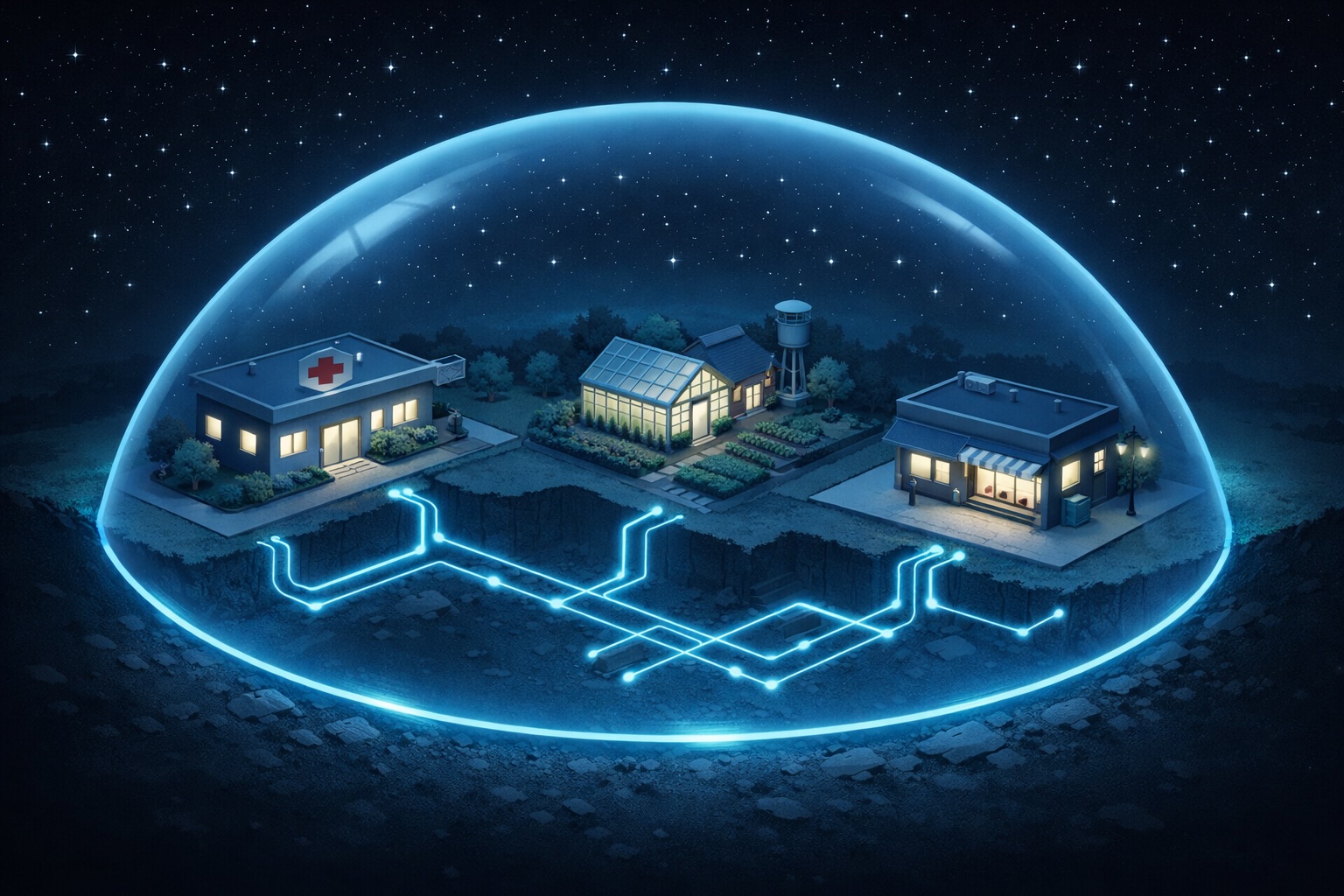
Project Sentinel: A Modular, Offline-First Edge AI Framework for Resilient Community Infrastructure
September 3, 2025

AI Data Centres: The New Backbone of National Competitiveness
November 19, 2025

Threat Landscape: Security Risks in Production Agentic AI Systems
June 13, 2026